
Recall Election
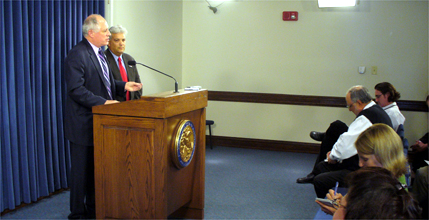
With the Illinois General Assembly�s regular session dragging on for months of overtime with no action to squarely address important public policy issues, Lt. Gov. Pat Quinn Thursday announced his full support for a proposed amendment to the Illinois Constitution, introduced by Rep. Jack Franks (D-Woodstock) and Sen. Dan Cronin (R-Elmhurst), to allow citizen recall of Illinois elected public officials.
�When everyday people fail to perform on the job, their employers don�t have to wait for years to hand them a pink slip,� Quinn said. �The people of Illinois employ their elected officials and pay their salaries, and they should have the right to fire them if those officials don�t perform as promised.�
In August, Rep. Franks proposed House Joint Resolution Constitutional Amendment 28 (HJRCA 28), which would amend the Illinois Constitution to give citizens the right to recall state executive branch officers, members of the General Assembly, and supreme, appellate, and circuit judges. Sen. Cronin introduced the legislation as SJRCA 70 in the Illinois State Senate.
�Recall is an extraordinary remedy for removing elected officials," said Rep. Franks. "This remedy is necessary to protect the public from governmental abuses of power and to reinforce our system of checks and balances. Eighteen other states have recall provisions in their constitutions. The citizens of Illinois deserve and need the same right to remove incompetent elected officials from office."
Under the proposed constitutional amendment, an effort to recall a state constitutional officer � the Governor, Lt. Governor, Attorney General, Secretary of State, Comptroller or Treasurer � would require signatures equal to 12% of the previous vote total for that office. For example, turnout in the 2006 election of the Governor and Lt. Governor totaled 3,486,671. So it would require at least 418,401 signatures to put a recall initiative on the ballot, and it would require approval by more than 50 percent of voters to recall the official.
�This amendment sets a reasonably high standard for recall of elected officials,� said Quinn. �Under this proposal, no hard-working elected official need fear a frivolous recall action, but the voters would be given the right to show their displeasure over serious official mistakes.�
The proposed constitutional amendment also sets guidelines for the recall of state legislators, and supreme, appellate, and circuit judges.
At present, 18 states permit the recall of state officials. The District of Columbia also provides for recall, as do local jurisdictions at least 29 states. In 1996, Minnesota voters approved an amendment to the state constitution allowing recall of elected state officials, and in 1993 a recall amendment passed in New Jersey by a 3-1 margin. Michigan, one of the first states to allow recall of elected officials, included a recall referendum provision in its 1908 revision of the state constitution. In the Midwest, Kansas and Wisconsin also allow recall of state officials.
Quinn has supported the right to recall for three decades, both as a citizen and as an elected official. Although recall efforts should not be undertaken lightly, Quinn says the mere possibility of recall gives elected officials an added incentive to deal fairly with the voters who put them into office.
As founder of the all-volunteer Coalition for Political Honesty, Quinn in 1976 led the biggest petition drive in state history, collecting 635,158 signatures and ending a century-old practice allowing Illinois legislators to collect their entire year�s pay on their first day in office.
In 1980, Quinn led the statewide campaign for the Cutback Amendment to the Illinois Constitution, which reduced the size of the Illinois House of Representatives from 177 to 118 members. The Cutback Amendment was the first and only amendment to the Illinois Constitution ever adopted by a citizen initiative.
A recall amendment to the Illinois Constitution would require a three-fifths majority vote in both houses of the General Assembly. If approved by legislators, the proposed amendment would be placed on the Nov. 4, 2008 ballot. To pass, the amendment would require approval by at least three-fifths of those voting on the question or a majority of those voting in the election.