
Illinois Rural HealthNet
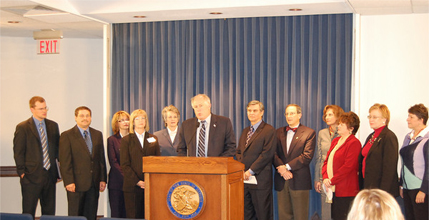
On Wednesday, November 28, 2007, Lt. Governor Pat Quinn joined with university and health care leaders from across Illinois at the State Capitol Blue Room to celebrate a $21-million federal grant that will connect rural hospitals and clinics across the Land of Lincoln to a shared fiber optic network that will significantly improve access to quality health care.
Illinois Rural HealthNet � a consortium of 12 universities and health care providers � won the three-year, competitive pilot grant from the Federal Communications Commission with a plan that virtually connects 85 locations from Chicago to Carbondale. The lightning speed fiber optic transmission will allow health care providers in rural areas to consult with specialists, monitor patients in remote locations, and transmit and receive large files such as MRI scans � all in a matter of minutes or even seconds.
This is crucial for the many Illinois citizens who have no local access to specialists in critical fields such as radiology, cardiology and neurology, and must travel great distances to obtain those services.
�Improving access to technology is the first step in improving access to life-saving health care services,� said Quinn who serves as chairman of the Broadband Deployment Council. �We want to salute Illinois Rural HealthNet for its commitment to bringing quality health care to Illinois communities. This is a shining example of what grassroots organizing can accomplish.�
In 2006, a group of research universities initiated discussions with hospitals and clinics interested in high-speed broadband access. While most saw enhanced connectivity as the answer to many rural health care challenges, few had the ability to obtain that access or connect to research networks.
Lt. Governor Quinn invited the newly formed Illinois Rural HealthNet consortium to use the Broadband Deployment Council as an organizing body and planning headquarters. Under the leadership of the Northern Illinois University Broadband Development Group, the consortium submitted the winning plan that will use federal seed money to connect statewide hospitals and clinics.
Illinois Rural HealthNet also plans to expand the network by inviting other public, non-profit and for-profit health care providers to utilize the broadband network for medical, psychiatric and educational purposes.
Lt. Governor Quinn is actively involved in improving high-speed Internet access for all Illinois residents. Serving as chairman of both the Illinois Main Street Council and the Illinois Broadband Deployment Council, Quinn has awarded and coordinated numerous grants to bring rural communities online. For more information, please visit IllinoisConnect.org.