
Mud to Parks Project
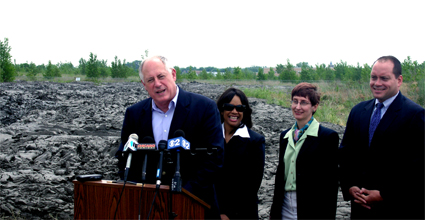
In an incredible feat of recycling, tons of silt clogging Illinois waterways are being reclaimed as rich topsoil for a new Chicago park, providing healthier habitat for native fish, better facilities for recreational boaters and new green vistas for urban residents - all thanks to the state of Illinois' nationally renowned Mud to Parks project. The new park site is at 8555 S. Green Bay Ave. in Chicago.
"It's amazing to realize that this simple concept - dredging up mud from a riverbed and spreading it out on dry land - can yield such enormous benefits to two Illinois communities over a hundred miles apart," Quinn said at the site. "Although it may look as though we're building the world's largest mud-pie, this project is actually improving the health of the Illinois River, making Peoria Lake more boater-friendly, and creating a new park that Chicago residents and visitors can enjoy for generations to come."
Quinn, who chairs the Illinois River Coordinating Council, greeted barges bearing tons of Illinois River mud, at the old U.S. Steel South Works site. Quinn was joined at the event by Chicago Park District Superintendent Timothy Mitchell, Illinois Department of Natural Resources Deputy Director Deboarah Stone, and Chicago aldermen Sandi Jackson (7th) and John Pope (10th).
In 2004, as part of the plan to redevelop the now-abandoned U.S. Steel factory site, the Mud to Parks project brought in 68 barges of silt - weighing 104,000 tons - to cover 17 acres of the slag with rich, fertile topsoil 2 to 3 feet deep.
The Mud to Parks program won a 2006 national Innovations Award from the Council of State Governments, which hailed the program for its imaginative approach to solving the problem of topsoil erosion and resulting sediment build-up in river-fed resorvoirs and backwaters.
The program is the brainchild of Dr. John Marlin, a senior scientist with the Waste Management and Research Center, a division of the Illinois Department of Natural Resources.
In February 2003, Quinn's office gave Marlin a grant of $75,000, which was used as seed money to begin the first Mud to Parks project, shipping mud from Peoria Lake to the South Works site.
The mud in this installment of the program has been dredged from a section of Peoria Lake, creating a channel 9 feet deep and 100 feet side near the East Port Marina in Peoria. By clearing the channel, the project improves recreation opportunities for boaters while creating new deepwater habitats for native fish.
The mud - enough to fill seven barges, each holding a load equivalent to 75 tractor-trailers - takes two days to make the trip upriver to Lake Michigan. The cost of the entire seven-barge shipment is approximately $275,000. The cost of this phase of the project is being covered by a $25,000 grant from the City of East Peoria and a $250,000 grant from the Illinois Department of Natural Resources.
Sedimentation is the single largest environmental problem facing the Illinois River. Once of the nation's most important fisheries, the Illinois River and its connected backwater lakes are now filling with sediments from topsoil erosion. Many areas that were 6 to 8 feet deep a century ago are now as shallow as 18 inches.
Later this summer, the Mud to Parks program will bring new topsoil to a landfill in Tazewell County to Duck Island at Rice Lake in Fulton County.